A logistics company once prided itself on competitive pay and a generous leave policy. On paper, it looked like a great place to work. Yet exit interviews kept surfacing the same complaint: new hires felt lost in their first month, managers rarely gave feedback outside annual reviews, and getting basic HR requests approved took weeks. Good pay could not outrun a frustrating day-to-day experience, and the company’s best performers kept leaving for less money elsewhere.
That gap between what a company offers on paper and what employees actually feel day to day is exactly what employee experience measures. And in 2026, it has become one of the clearest predictors of whether a business retains its people or keeps losing them.
What Is Employee Experience?
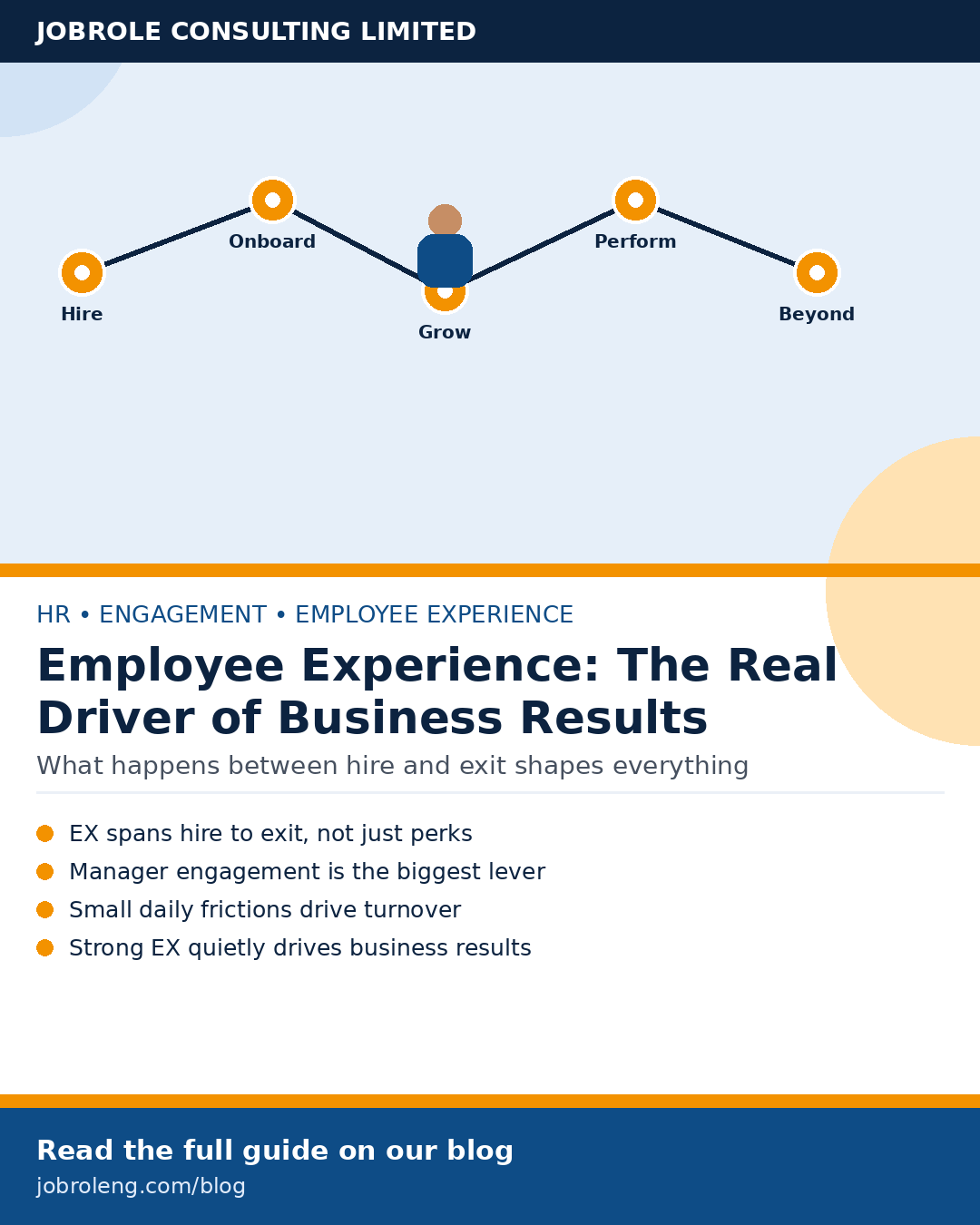
Employee experience, often shortened to EX, is the sum of everything an employee encounters at a company: how clearly they receive information, how smoothly they collaborate, how supported they feel by their manager, and how easily they can get their work done. It spans the entire employee lifecycle, from the first job posting they see to the exit interview on their last day.
Unlike employee engagement, which measures how motivated someone feels, employee experience looks at the conditions that produce that motivation in the first place: the tools, processes, culture, and relationships employees navigate every day.
Why Employee Experience Matters More in 2026
Global engagement numbers make the stakes clear. Worldwide employee engagement has been sliding, and manager engagement, arguably the biggest lever for team performance, has dropped even faster in the past year alone.
According to UC Today’s 2026 employee experience trends report, global engagement slipped from 23% to 21% in a single year, while manager engagement fell from 30% to 27%, with the sharpest declines among younger and female managers. When managers disengage, the effect cascades down through every team they lead.
This isn’t just an HR concern. Jobrole’s earlier look at why employees leave companies in Nigeria found that poor day-to-day experience, not just pay, was consistently among the top reasons good people walked away, a pattern now playing out globally too.
The Employee Experience Journey: Moments That Matter
EX is not one program. It’s a series of touchpoints, and each one shapes how an employee feels about the company:
- Attraction and hiring: how clearly a role is described and how respectfully candidates are treated during interviews.
- Onboarding: how quickly a new hire understands their role, tools, and team in the first 90 days.
- Day-to-day work: how smoothly employees can access information, get approvals, and collaborate without friction.
- Growth and development: whether employees can see a real path forward inside the company.
- Exit: how respectfully a departure is handled, which shapes the company’s reputation long after the employee leaves.
Jobrole’s earlier piece on the biggest recruitment challenges in Nigeria in 2026 found that candidate experience now shapes employer brand before someone is even hired, since candidates research company culture and employee reviews well before applying.
Common Employee Experience Gaps to Watch For
- A strong careers page but a confusing, slow interview process.
- Competitive pay paired with unclear expectations and infrequent feedback.
- Onboarding that ends after day one, leaving new hires to figure out the rest alone.
- Managers who were promoted for technical skill but never trained to lead people.
Each of these gaps quietly erodes trust, even when the company’s official policies look strong on paper.
How to Build a Stronger Employee Experience Strategy
- Map the full employee journey and identify where friction actually happens, not where you assume it happens.
- Treat manager development as core EX infrastructure, not an optional leadership perk.
- Close the feedback loop: if you survey employees, show them what changed as a result.
- Build structured onboarding that extends well past the first week.
This connects directly to what Jobrole outlined in learning and development as the missing link in team performance: employees who can see a growth path stay longer and perform better, and that growth path is a core part of the experience they have at work every day.
Employee Experience and Business Performance: The Real Connection
Employee experience is not a soft metric disconnected from the bottom line. It shapes retention, hiring costs, productivity, and even customer experience, since disengaged employees rarely deliver a great customer experience.
As Zoho’s 2026 employee experience trends overview puts it, experience today is shaped less by big HR initiatives and more by small, repeated daily interactions, and when those interactions are smooth, engagement rises and performance follows.
This is the same thinking behind Jobrole’s broader take on how people’s operations drive business success: when the systems around employees are built thoughtfully, the business results tend to follow on their own.
Frequently Asked Questions
What’s the difference between employee experience and employee engagement?
Employee experience refers to the conditions and touchpoints employees encounter at work, while employee engagement measures the motivation and commitment that results from those conditions. Strong EX tends to drive stronger engagement, not the other way around.
Who owns employee experience in a company?
HR typically coordinates EX strategy, but it is shaped by managers, IT, facilities, and leadership collectively, since experience touches every system and interaction an employee has, not just HR processes.
How can a small business improve employee experience without a big budget?
Start with the highest-friction moments: a clear onboarding plan, consistent manager check-ins, and fast responses to basic HR requests cost little but significantly improve how supported employees feel.
Conclusion
The logistics company from the opening story eventually rebuilt its onboarding process and introduced monthly, not annual, manager check-ins. Turnover among new hires dropped within two quarters, not because pay changed, but because the daily experience finally matched what the offer letter had promised.
That is the real lesson behind employee experience. Competitive pay gets people in the door. What keeps them, and what they contribute once they’re inside, depends on how work actually feels every single day.