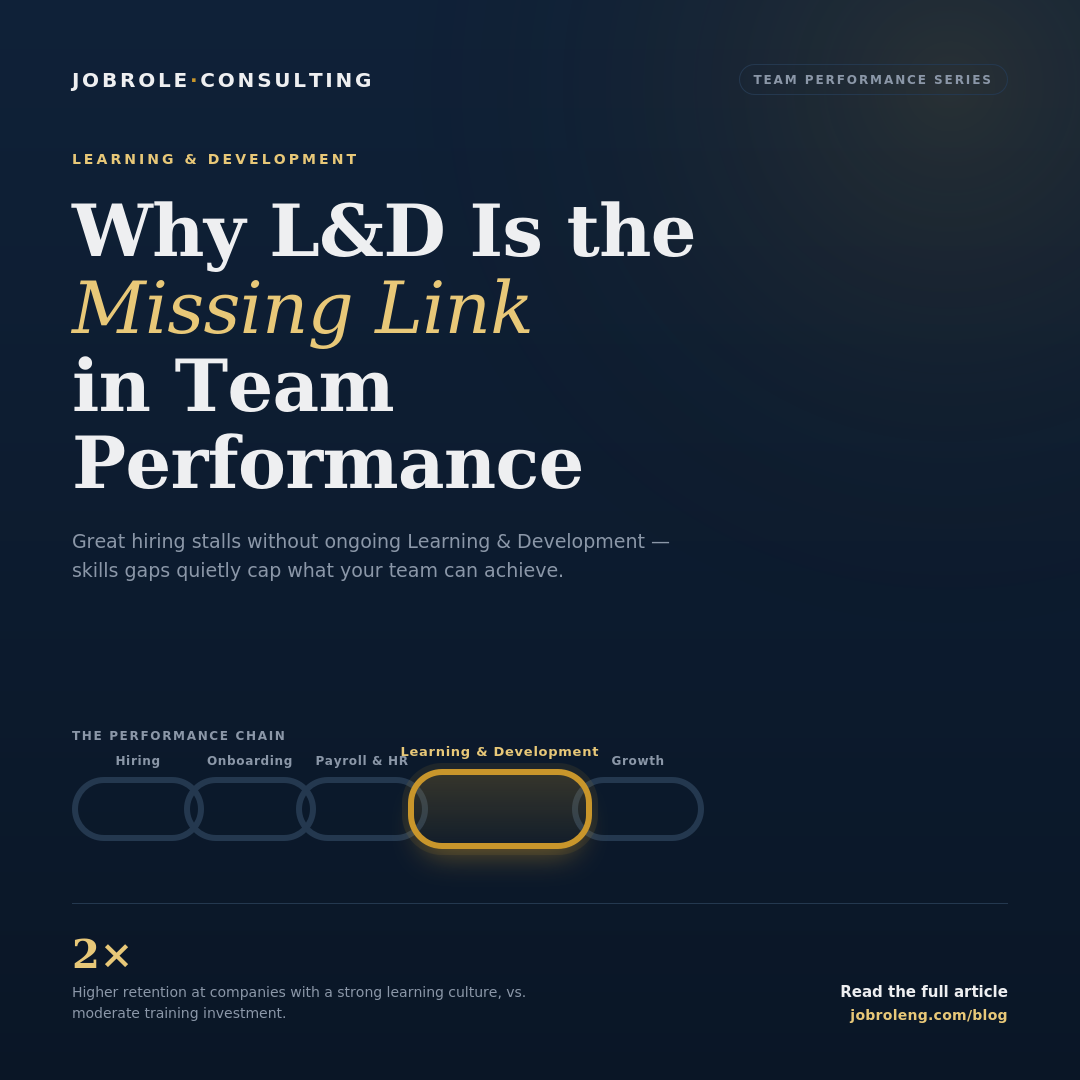
Most organisations chase performance through the obvious levers: better hiring, tighter processes, new tools, and stricter performance reviews. Budgets get approved for recruitment drives, software licences, and quarterly reviews, yet many teams still plateau, missing targets despite talented staff and reasonable systems. Managers often respond by tightening oversight or replacing people, assuming the problem is effort or fit. In a large share of these cases, the missing piece is neither talent, tools, nor effort. It is Learning and Development (L&D), the structured, ongoing process of building employee skills and closing capability gaps before they show up as missed targets. Without it, even a well-recruited, well-resourced team eventually stalls, because the roles, tools, and expectations around employees keep changing while their skills stay fixed.
This blog looks at why L&D is so often the overlooked variable in team performance, what the data says about the cost of leaving it out, and how a business can build a learning strategy that actually moves the needle rather than sitting as a line item nobody measures.
What Learning & Development Actually Means
Learning and Development refers to the deliberate, ongoing effort an organisation makes to build employee knowledge, skills, and competencies over time. It covers onboarding, technical upskilling, leadership development, soft-skills training, and reskilling for changing job demands. L&D differs from a one-off training session or an annual workshop: it is a continuous system tied to business goals, not an isolated event that appears once on the HR calendar and is then forgotten until the following year.
A properly designed L&D function starts with a skills or competency assessment, often supported by psychometric and pre-employment testing to identify existing strengths and gaps, then builds a learning path around what the business actually needs from each role. This assessment step matters because generic training, delivered without reference to real capability gaps, tends to be forgotten within weeks and rarely changes how people perform on the job. Effective L&D also assigns clear ownership: a named person or team responsible for tracking who has been trained, on what, and whether it changed anything measurable in their output.
The Cost of Ignoring L&D
Organisations that treat training as optional tend to pay for it elsewhere, usually in turnover, disengagement, and stalled output. Recent workforce research points to a consistent pattern across markets and industries, and the numbers are worth sitting with.
- Retention: according to Chanty’s 2026 employee training statistics report, companies with a strong learning culture report retention rates of roughly 57 percent, nearly double the 27 percent seen at companies with only moderate learning investment.
- Engagement and output: data compiled by Gitnux’s employee development research, drawing on Gallup’s workplace studies, finds that employees who receive regular training are roughly 3.5 times more likely to be engaged at work, with productivity gains of around 21 percent following from that engagement.
- Profitability: research summarised by Devlin Peck’s training statistics review shows that companies with comprehensive, formalised employee development programmes report income per employee that is over 200 percent higher than organisations without one.
- Strategic pressure: the LinkedIn 2025 Workplace Learning Report finds that a growing share of L&D and talent leaders say executives are already concerned employees lack the skills needed to execute business strategy, which is pushing learning from a standalone HR programme into a core part of talent planning.
Taken together, these figures describe the same problem from four angles: people leave faster, contribute less while they stay, generate less revenue per head, and leadership increasingly notices the capability gap before HR does. None of this is abstract. It plays out as missed deadlines, repeated onboarding costs, and managers quietly compensating for gaps that a structured learning path could have closed months earlier.
How L&D Directly Improves Team Performance
1. It closes the gap between hiring and doing
Recruitment gets the right person into the seat. L&D makes sure that person’s skills keep pace with what the role actually demands as it evolves, since job requirements rarely stay static for long. New tools, new processes, and new client expectations all shift the definition of good performance within months of someone starting. Without ongoing development, even a strong hire from a rigorous talent acquisition process will eventually fall behind the job, not from lack of ability, but because nobody invested in keeping their skills current.
2. It gives employees a reason to stay
Career stagnation is one of the most common reasons capable employees leave, even when pay is competitive. A visible, structured development path signals that growth is possible internally, which reduces the pressure to look elsewhere and protects the investment already made in recruitment and onboarding. Employees who can see a next step, whether that is a new skill, a certification, or a clearer route to a promotion, tend to give a company more patience during difficult periods than those who feel their role will look identical in three years.
3. It strengthens managers, not just individual contributors
Team engagement is heavily influenced by the quality of direct management, more than almost any other single factor. Investing L&D budget in supervisory and leadership training tends to multiply its effect across the organisation, since a better-equipped manager improves the output, retention, and morale of everyone reporting to them. Many companies default to training individual contributors first and leave managers to figure out leadership on their own; this is usually the wrong order, since a poorly prepared manager can undo the benefit of training everyone underneath them.
4. It supports internal mobility and succession
Employees who can move into new roles internally, because they were prepared for them through deliberate development, stay longer and contribute more than those who feel capped in place. This also reduces dependence on external hiring for every new opening, which is typically slower and more expensive than promoting from within. A team with a visible internal mobility pattern also builds a natural succession pipeline, so the business is less exposed when a key person leaves or is promoted.
Building an L&D Strategy That Actually Works
- Start with a real assessment: identify current skill levels and gaps against what each role actually needs, rather than guessing at training topics or copying a generic course catalogue from another company.
- Tie learning to business goals: every programme should map to a specific performance outcome, such as faster onboarding, fewer errors, or stronger client retention, not sit as a generic course library nobody is accountable for.
- Blend delivery methods: combine short-form digital learning, in-person workshops, and on-the-job coaching rather than relying on one format, since different roles and learning styles respond differently to each.
- Involve managers directly: training that a manager never reinforces on the job rarely changes behaviour, no matter how well the session itself was delivered.
- Measure what changed: track productivity, retention, and internal promotion rates before and after a programme, not just attendance or satisfaction scores, which say little about whether performance actually improved.
This is also where a broader HR consulting lens helps, since L&D works best when it is designed alongside compensation, performance management, and workforce planning rather than as a standalone initiative.
How Jobrole Consulting Can Help
At Jobrole Consulting Limited, Learning & Development is built as part of a wider talent strategy, not a bolt-on course catalogue. Our approach typically starts with a skills and competency assessment, often using structured psychometric and pre-assessment testing, followed by a tailored learning path aligned to your team’s actual performance goals. Because we also handle talent acquisition, payroll support, and HR consulting for our clients, we design L&D programmes that connect directly to hiring, retention, and long-term workforce planning, rather than existing in isolation.
Conclusion
Hiring well is only the first half of building a high-performing team. Without ongoing Learning and Development, even the best-recruited teams eventually plateau, disengage, or leave. Organisations that close this gap consistently outperform those that treat training as an afterthought, in retention, productivity, and profitability alike.
Ready to build an L&D strategy for your team? Talk to Jobrole Consulting about a tailored Learning & Development programme.