A startup went from 15 to 70 employees in under a year. Every new hire was handled the same way that worked when the company was small. The founder personally interviewed everyone, decisions happened over WhatsApp, and offers went out within days. It worked beautifully for 15 people. At 70, interviews got rescheduled constantly, feedback got lost in chat , and two departments ended up hiring for the same role without realizing it.
Nothing about the company’s ambition was wrong. The hiring process simply never grew up. Building a hiring process for a growing business isn’t about doing more of what worked early on. It’s about building structure before the cracks force you to.
Why Hiring Breaks Down During Growth
Most hiring processes are built informally, by instinct, by whoever is available, with decisions made in someone’s head rather than on paper. That works at a small scale because everyone can hold the full picture in memory. Growth removes that luxury. More roles, more interviewers, and more urgency expose every gap a casual process was hiding.
Jobrole’s earlier breakdown of the biggest recruitment challenges in Nigeria in 2026 found that slow, inconsistent hiring is one of the most common reasons growing Nigerian companies lose strong candidates to faster-moving competitors, even when the role and pay are nearly identical.
The Real Cost of Delay
Speed is not a vanity metric in hiring. Research on scalable hiring solutions for fast-growing companies found that roughly 26% of candidates drop out of a hiring process simply because it takes too long, often moving to employers who respond faster, regardless of how strong the original offer was.
A separate study cited by Cadient’s guide to scalable hiring for growing organizations found that 58% of job seekers lose interest entirely when a hiring process drags on, which means a slow process doesn’t just delay hiring. It actively filters out some of the best candidates before an offer is ever made.
The Building Blocks of a Hiring Process That Scales
- A clear, repeatable workflow: every role follows the same core stages, from job posting to offer, regardless of who is hiring.
- Defined hiring criteria for every role, agreed on before the job is posted, not during interviews.
- Structured interviews with scorecards, so decisions rely on evidence rather than whoever interviewed last and felt strongly.
- Clear ownership at each stage, so no candidate sits waiting because no one knows whose turn it is to respond.
- Verification built in by default for every role, not added as an afterthought once trust becomes a problem.
This verification step matters more than many growing businesses realize. Jobrole’s guide to background check trends and compliance updates for 2026 shows why skipping this step to move faster often creates far costlier problems later, especially as headcount and risk exposure both grow together.
A Step-by-Step Approach to Rebuilding Your Hiring Process
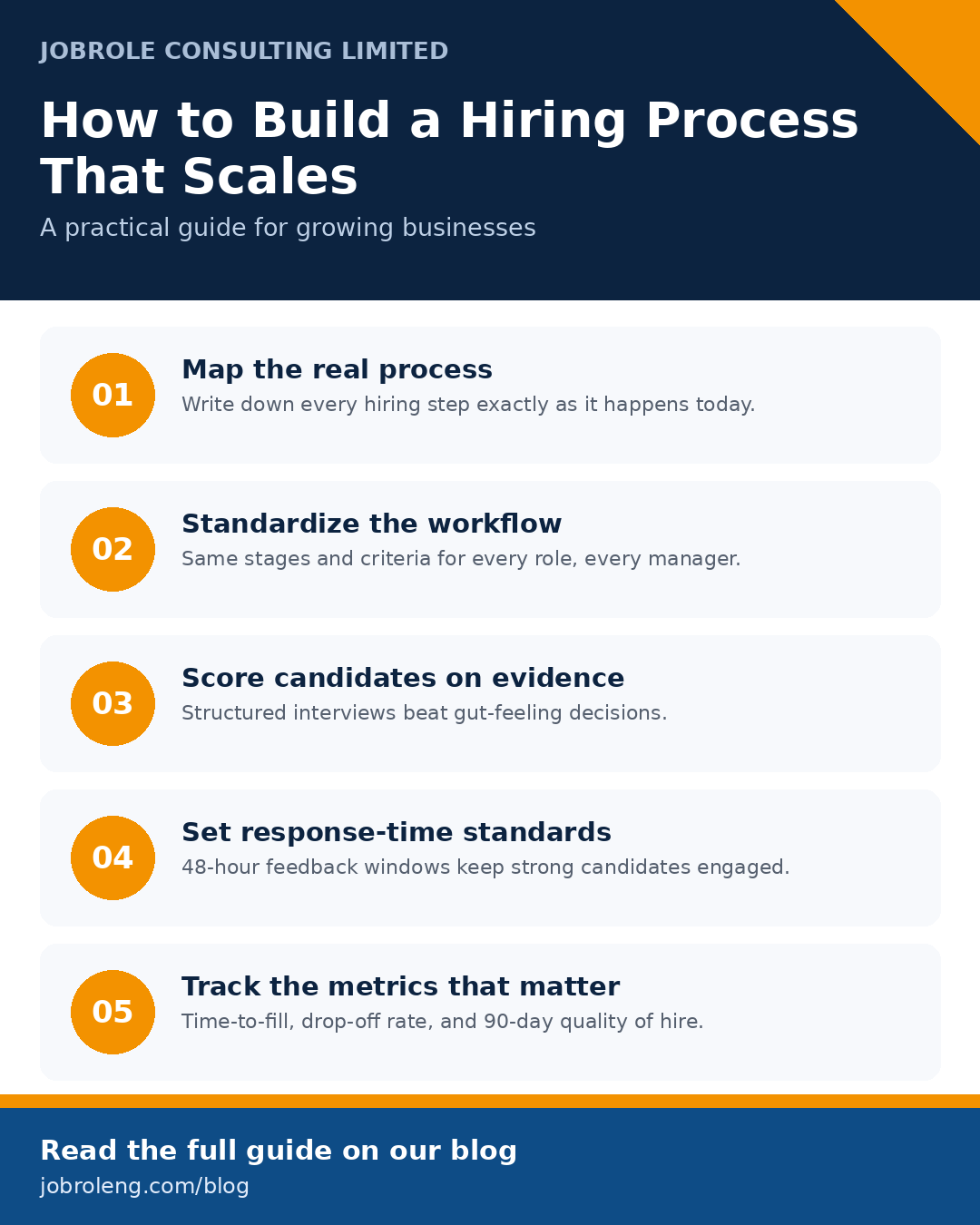
1. Map your current process honestly. Write down every step exactly as it happens today, not as it’s supposed to happen on paper.
2. Standardize job descriptions and interview stages across every department, so hiring doesn’t depend on which manager is running it.
3. Build simple scorecards for each role, covering the three to five things that actually predict success in that position.
4. Set response-time standards, such as 48 hours for interview feedback and a fixed window for offer decisions.
5. Track basic metrics: time-to-fill, drop-off rate, and quality of hire after 90 days, so you can see where the process actually breaks.
Why This Is Bigger Than a Recruitment Fix
A hiring process that scales isn’t only a recruitment concern. It is one of the clearest signals of whether a company is actually ready for the growth it’s chasing. Investors, partners, and future employees all read hiring speed and consistency as a proxy for how well-run a business is overall.
This is the same argument Jobrole made in why businesses in Nigeria need an HR consulting partner: companies that outgrow their founder-led processes without rebuilding them structurally tend to hit the same wall repeatedly, no matter how good the product or market opportunity is.
Businesses without dedicated recruitment capacity don’t need to build all of this alone. Jobrole’s look at HR outsourcing trends transforming the pace of HR in 2026 shows how outsourcing structured hiring support lets growing teams move fast without sacrificing the consistency that protects quality of hire.
Avoiding the Most Common Mistake
The single most common mistake growing businesses make is rushing hiring decisions to fill urgent gaps, then dealing with the consequences later.
Jobrole explored this pattern directly in why companies keep hiring the wrong people and how to fix it: urgency is rarely the real problem. An undefined process that collapses under urgency is. Fixing the process removes the pressure that leads to rushed, costly hiring mistakes in the first place.
Frequently Asked Questions
At what company size should a business formalize its hiring process?
There’s no fixed headcount trigger, but most businesses start feeling the strain between 20 and 50 employees, when informal, founder-led hiring can no longer keep pace with the number of open roles.
Does a structured hiring process slow things down?
Done well, it speeds things up. Structure removes the back-and-forth and uncertainty that cause delays, replacing ad-hoc decisions with a clear, repeatable path from application to offer.
What’s the fastest way to start improving a messy hiring process?
Start by mapping the current process exactly as it happens today. Most inefficiencies become obvious once they’re written down, long before any new tool or system is introduced.
Conclusion
Mapping out the hiring workflow, assigning clear ownership at each stage, and setting basic response-time standards will drop the hiring cycle, not because the company slowed down to add process, but because the process finally matched the size of the business running it.
A growing business outgrows almost everything it started with – its tools, its org chart, sometimes its office. Hiring should be no different. The businesses that build for scale early are the ones that keep growing without hiring becoming the bottleneck that stops them.