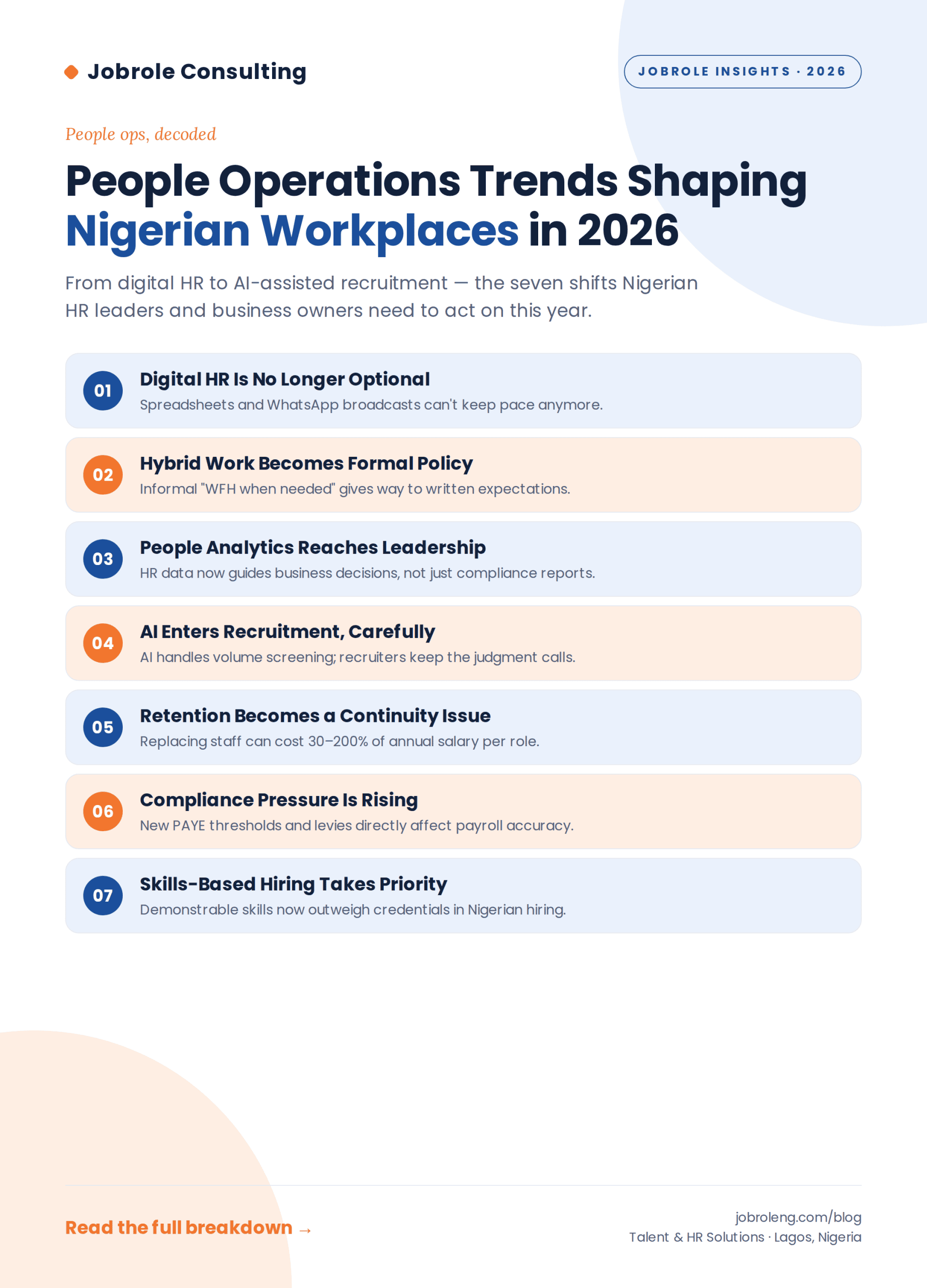
Nigerian HR departments are no longer just processing payroll and filing leave requests. In 2026, people operations has become a strategic function that touches everything from business continuity to compliance to competitive advantage. Companies that treat HR as an afterthought are already losing ground to competitors who treat their workforce as a data-driven growth engine.
Below are the trends defining Nigerian workplaces this year, and what HR leaders and business owners should be doing about each one.
1. Digital HR Is No Longer Optional
For years, digital HR platforms were seen as a big company investment. That has changed. Manual, spreadsheet-based HR systems simply can’t keep pace with the volume and speed Nigerian businesses now operate at a shift reflected in Deloitte’s 2025 Africa Human Capital Trends report, which found that HR platform adoption among medium-sized African enterprises has more than doubled in five years.
The pressure isn’t cosmetic. Businesses that automate payroll, onboarding, and attendance tracking are cutting processing time from days to hours while reducing costly errors. If your HR function still runs on spreadsheets and WhatsApp broadcasts, 2026 is the year to close that gap; starting with the processes that eat the most staff hours: payroll, leave management, and attendance.
2. Hybrid Work Moves From Experiment to Policy
Remote and hybrid work in Nigeria has outgrown its pandemic leftover reputation. It’s now a structural part of how knowledge-based industries; marketing, fintech, professional services, tech operate. Adoption is uneven across sectors, with urban, knowledge-driven businesses leading the way while manufacturing and traditional industries lag behind, according to PwC’s 2025 Africa workplace study.
What’s changed for 2026 is formalization. Companies are moving away from informal “work from home when you need to” arrangements toward structured hybrid policies covering expectations, tools, and accountability. Businesses that skip this step risk inconsistent output and unclear performance expectations across teams.
What to do: Put your hybrid policy in writing – covering core hours, communication expectations, and equipment rather than leaving it to informal manager discretion.
3. People Analytics Becomes a Leadership Tool, Not Just an HR Report
HR data used to exist for compliance and reporting. In 2026, it’s being used to predict attrition risk, flag disengagement early, and guide business decisions at the leadership level. Organizations that reposition HR as a strategic intelligence function rather than a reactive administrative one are gaining a measurable edge over competitors still flying blind.
This mirrors what global research is showing too: Deloitte’s 2026 Global Human Capital Trends survey found that most business leaders now see speed and adaptability powered by better workforce data as their primary competitive strategy.
What to do: Even without an enterprise HRIS, start tracking a handful of core metrics ; time-to-hire, voluntary turnover, absenteeism, and engagement survey scores on a simple dashboard reviewed monthly with leadership.
4. AI Enters Nigerian Recruitment — Carefully
AI-assisted candidate screening, video-interview platforms, and analytics tools that track hiring effectiveness are becoming standard parts of the Nigerian recruitment process rather than novelties, per EMEA Talent Solutions’ 2026 recruitment trends report. At the same time, Nigerian professionals are increasingly stepping into strategic, not just operational, roles – meaning recruitment now has to identify leadership potential, not just role fit.
The caution here is real: AI tools used carelessly can introduce bias or filter out strong candidates for the wrong reasons. The trend for 2026 isn’t “AI replaces recruiters”, its AI handling volume and first-pass screening while human recruiters focus on judgment calls, culture fit, and closing candidates.
5. Retention Becomes a Business Continuity Issue
Replacing an employee can cost between 30% and 200% of their annual salary depending on role complexity; a cost that hits harder in markets where recruitment cycles already run long. Employee experience is expanding well beyond salary to include clear career progression frameworks, something many Nigerian organizations have historically left informal or undefined.
A key blocker: many managers were never actually trained to manage people. Employee experience is increasingly becoming a leadership responsibility that HR alone can’t carry.
What to do: If you don’t already have a documented career progression path for each role, build one. It costs almost nothing and is one of the highest-leverage retention tools available.
6. Compliance Pressure Is Rising – Tax and Labour Reform
2026’s fiscal changes – including new PAYE thresholds and consolidated levies directly affect compensation strategy and payroll compliance for Nigerian employers, according to ICS Outsourcing’s 2026 workforce planning guide. Getting this wrong isn’t just an admin problem- it risks penalties and can quietly erode employee trust if payslips don’t reflect the new rules correctly.
What to do: Audit your payroll structure against the current PAYE and levy requirements now, rather than waiting for a compliance issue to force the review.
7. Skills-Based Hiring and Reskilling Take Priority
With AI and automation absorbing routine tasks, the emphasis in Nigerian hiring is shifting from credentials toward demonstrable skills ; digital literacy, AI proficiency, and adaptability in particular. Organizations are increasingly building internal upskilling programs rather than assuming they can always hire their way out of a skills gap.
This also shows up in how companies source talent: several Nigerian employers are now looking beyond traditional degree pipelines toward bootcamp graduates and skills-assessed candidates to fill gaps in fast-growing sectors like fintech and agritech.
Preparing Your Organization for 2026
None of these trends require a complete HR overhaul overnight. The organizations pulling ahead in 2026 are the ones making deliberate, incremental moves:
- Digitize one process at a time. Start with payroll or leave management, not everything at once.
- Write down your hybrid policy instead of leaving it to informal team norms.
- Track a small set of people metrics monthly, even without expensive software.
- Review compensation and payroll structure against the latest tax and labour changes.
- Build (or document) career paths for your key roles to protect retention.
If you’d rather have an experienced partner handle this shift, Jobrole Consulting works with Nigerian businesses on recruitment, HR outsourcing, and management consulting to help teams modernize without disrupting day-to-day operations. You can learn more about the team behind this work on the Jobrole Consulting about page.