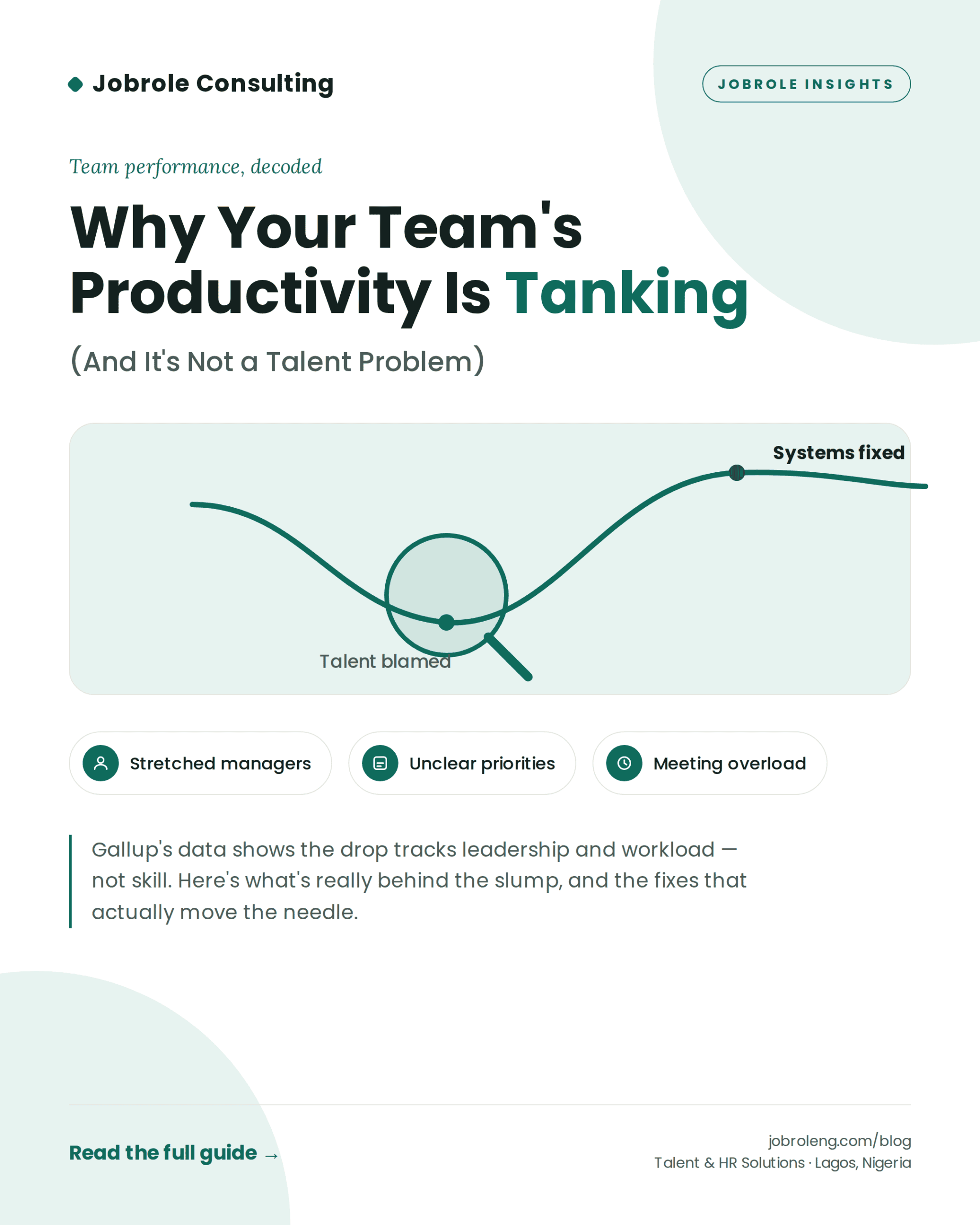
Every manager has had the thought: my team just isn’t performing the way it used to. Deadlines missed, Energy dips, and Output slows. Someone misses a target that used to be routine, and the instinct is to look at the people first ; maybe the hiring was off, maybe the team lacks drive. But before you start auditing individual talent, consider this: worldwide employee engagement has been sliding for the second year running, based on Gallup’s ongoing global workplace study, and the decline tracks far more closely with how teams are led and supported than with any shortage of skill.
That distinction matters for any business owner or HR lead trying to solve a team productivity problem. Treating it as a talent problem leads to hiring freezes, performance write-ups, or expensive replacement cycles. Treating it as a systems problem leads somewhere far more useful: a short list of fixable causes.
The Talent Myth: Why Blaming Your People Is the Wrong Diagnosis
When team productivity drops, blaming individual performance is the easiest and least accurate explanation. Gallup’s research attributes roughly seven in ten points of variance in team engagement directly to the manager, not the individual contributor: when output slows across a team, the pattern usually points upward, to leadership and systems, before it points at any one employee.
That matters because it changes where you look for a fix. Replacing talent is expensive and slow, and rarely solves a problem rooted in unclear priorities or broken workflows. Fixing the system usually costs less, works faster, and protects institutional knowledge you’d otherwise lose by turning over staff who were never the problem.
The Real Reasons Team Productivity Is Slipping
1. Managers Are Stretched Thin and Losing Motivation
Disengaged managers are one of the clearest drivers of falling team output. Under pressure from restructuring, tighter budgets, and rising expectations, they often have little capacity left to coach or unblock their teams and that strain shows up directly in performance, even when individual employees haven’t changed at all.
2. Unclear Priorities Create Invisible Friction
When a team doesn’t have a shared, current answer to “what matters most this week,” people default to busyness instead of productivity. Competing priorities from different stakeholders quietly drain hours that never show up on any dashboard.
3. Meetings and Notifications Are Eating Deep-Work Time
Constant context-switching between meetings, chat pings, and email is one of the most underestimated productivity killers. A team can be fully staffed with strong performers and still fall behind simply because no one has protected blocks of uninterrupted work time.
4. Skills Gaps Nobody Is Actively Closing
Productivity often stalls not because people lack ability, but because they were never equipped for what the role now demands. We covered this in more depth in Learning & Development: The Missing Link in Your Team’s Performance — a gap in structured learning shows up as a gap in output, and it’s easy to misread it as a talent problem instead.
5. Recognition and Feedback Are an Afterthought
Teams that rarely hear what’s working only what’s going wrong tend to disengage from the effort altogether. Recognition isn’t a soft perk; it’s one of the cheapest, fastest levers for restoring momentum on a struggling team.
6. Burnout Is Quietly Eroding Psychological Safety
When people are running on empty, they stop raising problems early, stop asking for help, and stop offering new ideas not because they don’t care, but because they no longer have the bandwidth to. That silence is easy to misread as disengagement or a lack of drive, when it’s really a symptom of a team that’s been running at an unsustainable pace for too long without anyone naming it.
How to Fix a Productivity Problem That Isn’t About Talent
Once you accept that the cause is structural, the fix list becomes fairly short and concrete.
Invest in Manager Training First
Because managers drive most of a team’s engagement, this is the highest-leverage fix. Coaching, prioritization, and feedback training pays off across everyone that manager leads.
Re-Align Priorities on a Regular Cadence
A short weekly check-in on what actually matters this week prevents effort from quietly leaking into low-value work. It also gives managers an early warning system for competing demands before they become bottlenecks.
Protect Deep-Work Time
Audit recurring meetings and cut or shorten anything that doesn’t need a live discussion. Even two protected hours a day of meeting-free time can meaningfully lift output on knowledge-work teams.
Close Skills Gaps With Structured Learning
Rather than assuming underperformance, check whether the team has actually been equipped for what the role now requires. Structured, role-specific development not one-off training days is what closes this gap for good.
Build Recognition Into How the Team Operates
Recognition works best as a habit, not an event. A short weekly moment naming what went well, folded into an existing meeting, does more for morale than an annual awards ceremony.
Watch for Burnout Before It Shows Up in the Numbers
Regular, honest check-ins not just performance reviews give managers a chance to catch unsustainable workloads before they turn into resignations or a quiet drop in quality.
The Bottom Line
Before you question your team’s talent, question the system around them. Most productivity slumps are systems problems wearing a talent costume, unclear priorities, stretched managers, meeting overload, skills gaps, thin recognition, or quiet burnout. Systems problems, unlike talent problems, are almost always fixable once you know where to look and the teams that fix them tend to come back stronger than they were before the slump started.