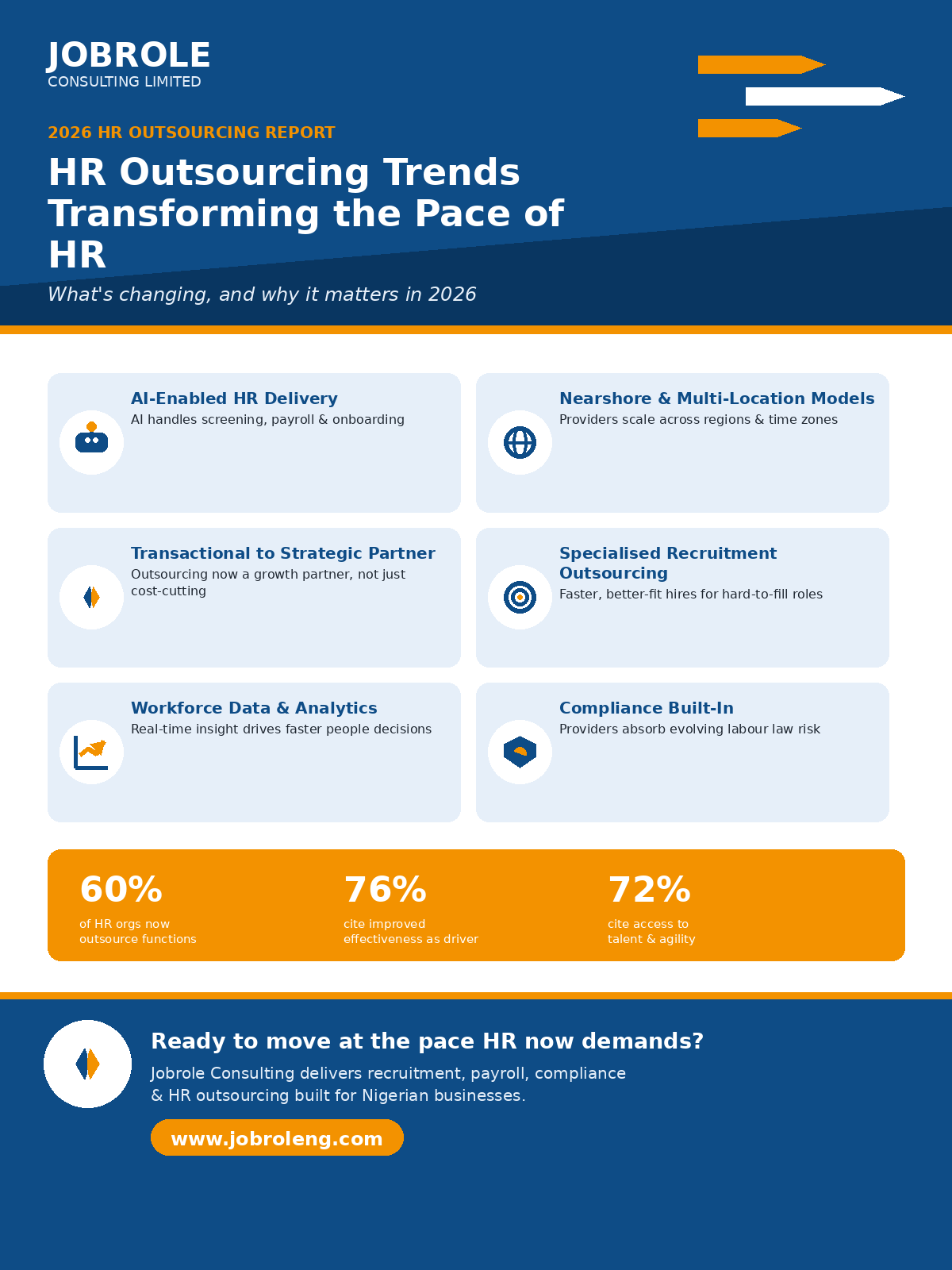
HR used to move at the speed of paperwork. In 2026, it’s expected to move at the speed of the business, and for most in-house teams, that’s a gap outsourcing is increasingly closing. As AI adoption, distributed workforces and stricter compliance demands stack up, HR outsourcing has shifted from a cost-saving tactic to a core part of how competitive companies now build their people operations. Here’s what’s driving that shift, and what it means for employers in Nigeria and beyond.
1. AI-Enabled HR Service Delivery
AI is no longer a future concept in HR outsourcing, it’s operational. Providers now use AI for payroll processing, candidate screening and onboarding automation, cutting manual errors and accelerating turnaround times. Few in-house teams have the budget or bandwidth to build this kind of automation themselves, which is exactly why more organisations are turning to specialist providers who already have it built.
2. The Rise of Nearshore and Multi-Location Models
Distributed hiring has made location strategy a core outsourcing decision, not an afterthought. Providers with multi-location delivery models let companies scale HR support closer to their working hours and talent pools, improving both response times and cultural fit. This shift mirrors a broader move in outsourcing generally, away from a single low-cost hub toward multiple, strategically placed delivery centres.
3. From Transactional to Strategic Partnership
Cost savings used to be the headline reason for outsourcing HR. That’s changed: Deloitte’s Global Outsourcing Survey found nearly 60% of HR organisations already outsource HR functions, with effectiveness, talent access and agility now cited as bigger drivers than cost. Providers are expected to function as an extension of the business, offering workforce planning and change management support, not just payroll processing.
4. Specialised Recruitment Outsourcing
Generic hiring support is losing ground to specialized recruitment process outsourcing, providers who understand a specific industry, role type or market well enough to fill hard roles faster and with better long-term fit. For employers competing for scarce, high-demand skills, this specialisation is often the difference between a six-week hire and a six-month one.
5. Workforce Data and Analytics
Outsourcing providers increasingly bring real-time workforce analytics that most internal HR teams don’t have the tools or headcount to build in-house. From attrition risk to time-to-hire benchmarking, data-driven insight is turning HR from a reactive administrative function into a source of decisions the business actually uses.
6. Compliance Is Built Into the Service, Not Bolted On
Labour regulation is getting more complex, not less, and the cost of getting it wrong keeps rising. Outsourcing providers absorb much of that regulatory risk by building compliance directly into their service delivery, payroll tax rules, statutory filings, employment law updates, so internal teams aren’t tracking every change themselves.
What This Means for Nigerian Employers
These trends aren’t playing out only in North America and Europe. Nigerian businesses face their own version of the same pressure: hybrid work expectations, rising compliance requirements, and a talent market where speed and specialisation win. Organisations pairing outsourced payroll and compliance with structured recruitment and background verification are consistently hiring faster and reducing administrative risk, without needing to scale internal HR headcount at the same pace as the business.
This is where Jobrole Consulting Limited fits in. Beyond recruitment and background verification, Jobrole supports Nigerian businesses with HR consulting, payroll and learning & development, giving growing companies outsourced HR support built specifically for how business is done locally. If you’re rethinking how HR should function inside your organisation in 2026, the Next Frontier Conference, Jobrole’s flagship entrepreneurship and business event, is where these exact conversations are happening in person.
Frequently Asked Questions
What is HR outsourcing?
HR outsourcing means delegating HR functions, such as payroll, recruitment, compliance or benefits administration, to an external specialist provider instead of managing them fully in-house.
Is HR outsourcing only for large companies?
No. Small and mid-size businesses are increasingly the fastest-growing segment of HR outsourcing users, since it lets them access specialist expertise and technology without building a large internal HR department.
What HR functions are most commonly outsourced?
Payroll processing and benefits administration remain the most commonly outsourced functions, with 54% of organisations outsourcing benefits administration and 53% outsourcing payroll processing, though recruitment, compliance and workforce analytics are growing quickly as outsourcing categories.
Does outsourcing HR mean losing control over people’s decisions?
Not when it’s structured well. Strategic outsourcing partners work as an extension of the internal team, providing expertise and execution while the company retains decision-making authority over its workforce.
Conclusion
HR outsourcing in 2026 isn’t about doing less, it’s about doing more, faster, with fewer internal bottlenecks. As AI, compliance complexity and talent competition all accelerate at once, the employers pulling ahead are the ones treating outsourcing as a strategic capability rather than a cost line. The pace of HR has changed permanently, and the organisations built to match it will be the ones best positioned to grow.
Ready to outsource with confidence? Talk to Jobrole Consulting about recruitment, payroll, compliance and HR support built for Nigerian businesses.