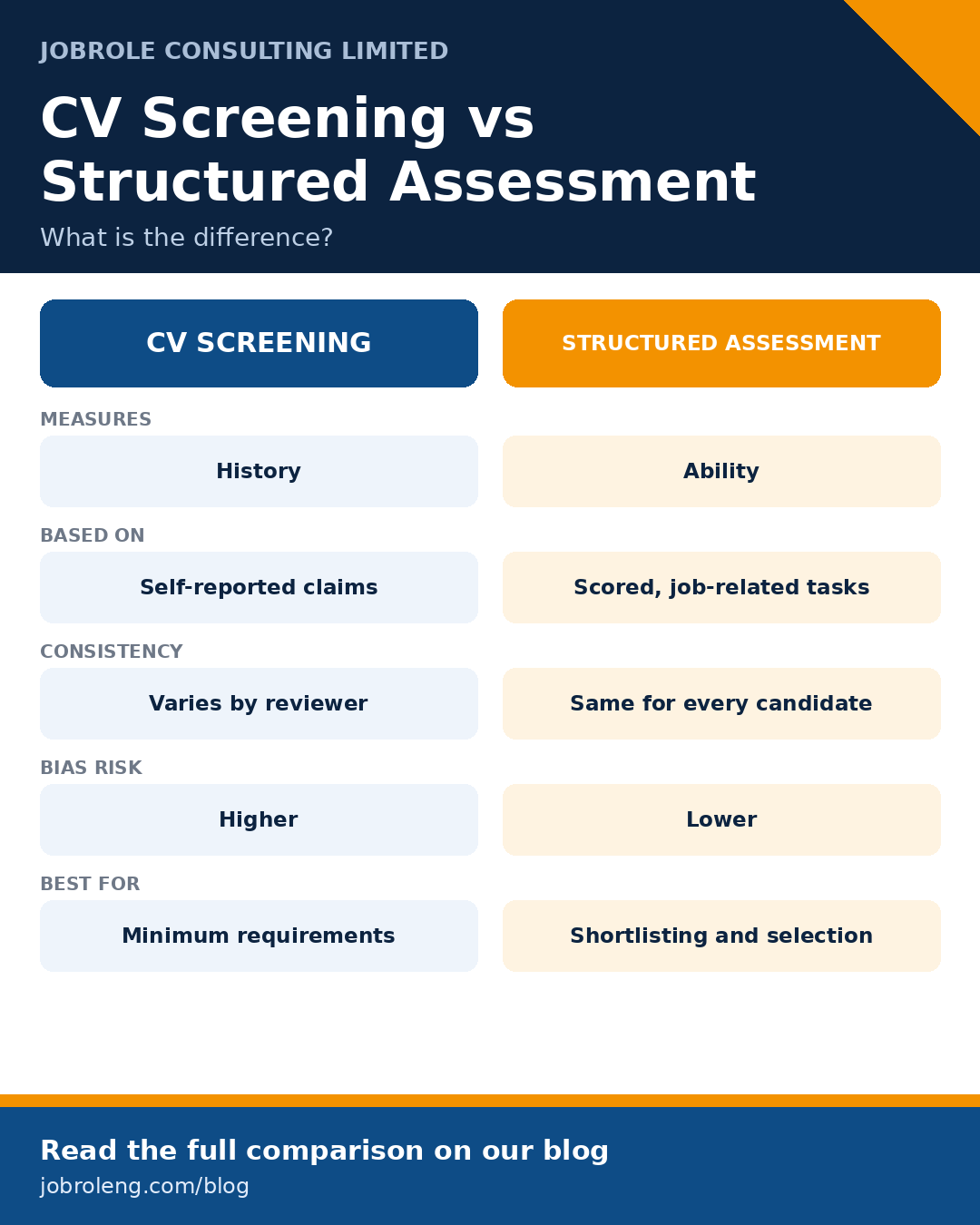
Employers use two broad approaches to decide who moves forward in hiring: reviewing what a candidate has done, and measuring what a candidate can do. CV screening is the first. Structured assessment is the second. Understanding the difference between CV screening and structured assessment helps businesses choose the right method for each stage of hiring and avoid costly mismatches.
CV screening reviews a candidate’s history: qualifications, job titles and experience as the candidate reports them. Structured assessment measures a candidate’s ability against predefined role criteria, using the same questions or tasks and the same scoring for every applicant.
What Is CV Screening?
CV screening is the review of applications to confirm that a candidate meets the minimum requirements for a role. It is quick and inexpensive, which is why nearly every hiring process starts with it. Its limitation is what it measures. A CV records past positions and credentials. It does not show how well someone will perform in a new role, and the information on it is usually self-reported.
That second point matters in Nigeria’s market. Jobrole’s report on fake certificates and job scams shows how credentials on paper can be forged, which is why CV claims should be treated as unverified until confirmed.
What Is a Structured Assessment?
A structured assessment evaluates candidates with standardised, job-related methods that are scored consistently. Common formats include:
- Structured interviews: every candidate answers the same questions, scored against a rating guide.
- Work samples and skills tests: candidates complete a task that mirrors the job.
- Cognitive and aptitude tests: timed tests of reasoning and problem solving.
- Situational judgement tests: candidates respond to realistic workplace scenarios.
CV Screening vs Structured Assessment: Side-by-Side Comparison
| Criteria | CV Screening | Structured Assessment |
|---|---|---|
| What it evaluates | Work history, qualifications, job titles, years of experience | Demonstrated ability against defined role criteria |
| Predictive accuracy | Low. Education and experience indicators typically sit around 0.10 | Higher. Structured interviews and work samples typically fall between 0.42 and 0.58 |
| Consistency | Varies by reviewer | Same questions and scoring for every candidate |
| Risk of bias | Higher: names, schools and employers can influence reviewers | Lower when criteria and scoring are set in advance |
| Exposure to false claims | High: information is self-reported and unverified | Lower: candidates demonstrate skills directly |
| Speed and cost | Fast and low cost | Slower and costlier per candidate |
| Best used for | Confirming minimum requirements | Shortlisting and final selection decisions |
Why CV Screening Alone Falls Short
Meta-analytic research consistently ranks CV-based indicators low as predictors of job performance. A comparison of candidate assessment methods by The Test Partnership notes that years of education and past experience typically show predictive accuracy around 0.10, while structured interviews reach roughly 0.58 and cognitive ability tests 0.65 in the studies it cites.
Newer analyses have revised some of these older figures downward. Structured interviews, for example, are often placed nearer 0.42 in more recent estimates. The ranking holds either way: structured methods predict performance better than CV review, though exact values depend on the role and on how well the assessment is designed.
There are three further weaknesses. CV review is inconsistent, because two reviewers can reach different conclusions on the same application. It is open to unconscious bias, since names, schools and employers can sway judgement. And it overlooks capable candidates whose backgrounds do not follow a conventional path.
Where Structured Assessment Has Limits
Structured assessment is not a free upgrade. It takes more time and budget per candidate, it requires a clear definition of what success looks like in the role, and a poorly designed test can be as misleading as a poor CV review. Candidates also need a reasonable experience of the process, as long or irrelevant assessments drive applicants away.
For high-volume roles, KnowledgeCity’s analysis of talent assessments in high-volume hiring argues that screening errors multiply at scale, which is where objective, scored assessment adds the most value.
How to Combine Both Methods
The two methods are complementary, not competing. A practical sequence for most roles is:
1. Use CV screening to confirm minimum qualifications and eliminate clear mismatches.
2. Apply a skills test or aptitude assessment to shortlist on demonstrated ability.
3. Run a structured interview with a scorecard for the remaining candidates.
4. Verify credentials and employment history before the offer is made.
The final step is not optional. Current background check trends and compliance requirements outline how verification closes the gap that unverified CV claims leave open.
Businesses that hire the wrong people usually skip one or more of these stages, as explained in why companies hire the wrong people and how to fix it. Teams without in-house capacity to design assessments can bring in an external partner, a case made in why Nigerian businesses need an HR consulting partner.
Frequently Asked Questions
Is CV screening still worth doing?
Yes, as a first filter for minimum requirements. It should not be the only basis for a hiring decision.
What is the most predictive hiring method?
Research points to structured interviews, work samples and cognitive ability tests as the strongest individual methods, with the best results coming from combining them.
Are structured assessments suitable for small businesses?
Yes. A scorecard-based structured interview and a short role-specific task require little investment and can be introduced without specialist software.
Does structured assessment remove bias completely?
No, but it reduces it. Consistent questions and pre-agreed scoring criteria limit the influence of personal impressions on the decision.
Conclusion
CV screening tells an employer what a candidate says they have done. Structured assessment shows what a candidate can do. Used together, with verification before the offer, they give businesses a more reliable view of who will perform in the role.
Jobrole supports employers with pre-assessment and background verification as part of a structured hiring process.